Postcards from Paris: A Wander Through Montmartre
This post is the slow version of my Instagram reel from Paris. Watch the reel first, then come back here to sit with each image a little longer
Last time I shared with you my love of the Bloomsbury group and my connection to the area. I left London for Bath in late September of 1993. I felt like I was entering another world, and I clearly remember Nick saying, “this place is full of beautiful people”. Georgian architecture for princes and princesses – well if you compared it to gritty London. Being a Londoner, always looking out, meant that I was safer than most and looked deeper. Bath College of Higher Education was set in a Georgian crescent, with a sweeping silhouette and port holes in the rooftop looking over the sepia toned city.
My first trip to Paris was from there, and with this outsider view of the world I started to see the city in “technicolour”. What I mean is not just seeing but deeply feeling and holding onto in my head. The smells, sounds, the chance happenings and the enigma – mysterious and sometimes puzzling. I wrote a dissertation on the surrealist leader André Breton and looked closely at the surrealist techniques used in the creation of art. They relied on the spontaneous, unconscious psychic automatism, unexpected juxtapositions, personal icons and universal symbolism, and it shaped how I see Paris now.
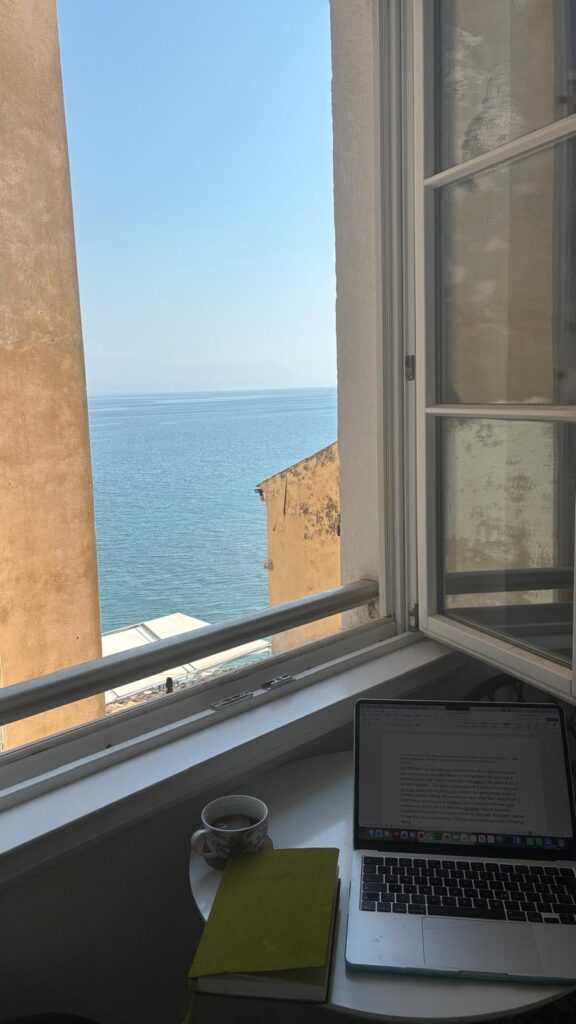
Ps I’m sitting in the Corfu flat and it’s wonderful. No one is here, just me and the rumble from the occasional boat, the aircon wisping, and the clock softly ticking. My camera records shadows on the walls in the block opposite, it has long elegant fingers. I am reminded of George Melly’s book Paris and the Surrealists and I’m taken back to Paris again.
Melly talks about surrealism being the soul of Paris, perhaps this is what I’m looking for in each location. It all began with my coming across the book Nadja by André Breton in 1994. It’s an autobiographical book based on a ten-day love affair with a young visionary woman. The book intertwines drawings and black and white photos with text. In Melly’s book he uses the photographer Michael Woods to capture his Paris. A beautiful book, glossy black and white photos of Paris.
If you’d like to read more before your own trip to Paris — Nadja by André Breton, and Paris and the Surrealists by George Melly with photography by Michael Woods, are both still in print and worth tracking down.
I will start by saying avoid the Abbesses Metro as it has 222 steps up to street level and is a killer! There are two other options nearby, much easier: getting off at Pigalle or Blanche instead means a normal street-level exit.
1. Hotel Basss
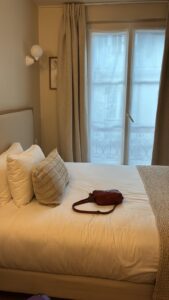
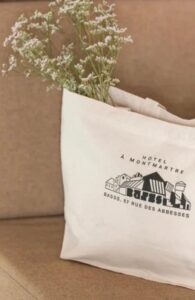
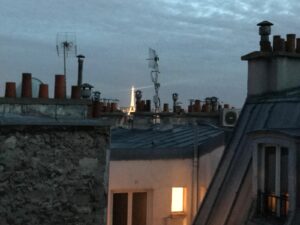
The opening photo in the Instagram reel is my landing in a room at Hôtel Basss in Montmartre, on Rue des Abbesses. It’s my favourite little boutique hotel with immediate access to the streets of coffee drinkers and diners. You can stroll the independent boutiques, the bars, sit and sketch the Parisians and then be back in your room in minutes. An easy life. This trip was my second attempt at bringing friends along. Last year the hotel cancelled, the building was unsafe! Rooms are Rosie sized – with a small lift, narrow staircase and bathroom, as it seems quite a lot of the accommodation around the old parts of Paris are. I feel relaxed and know where I am here, home away so it begins here.
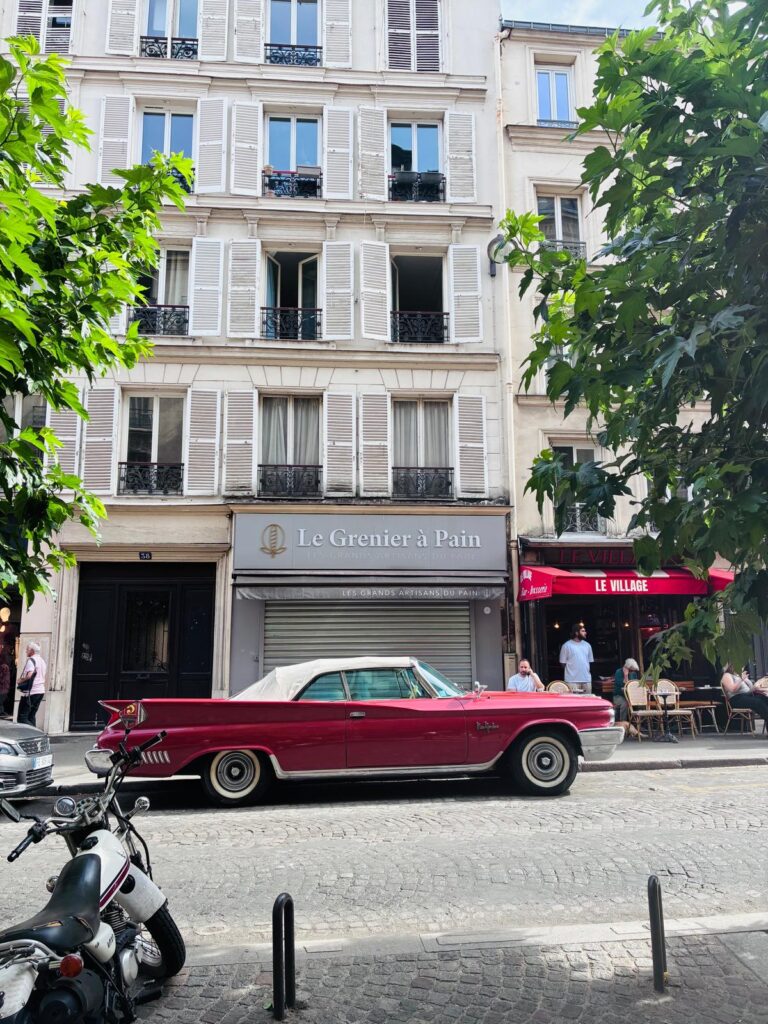
2. An American Car
Just opposite the hotel there was a lovely American car, it remained planted there all weekend. It’s a tug from my young father who owned a gold Cadillac and drove round Soho back in the 1960s. Objects of colour are sometimes signs for my memory notebook.
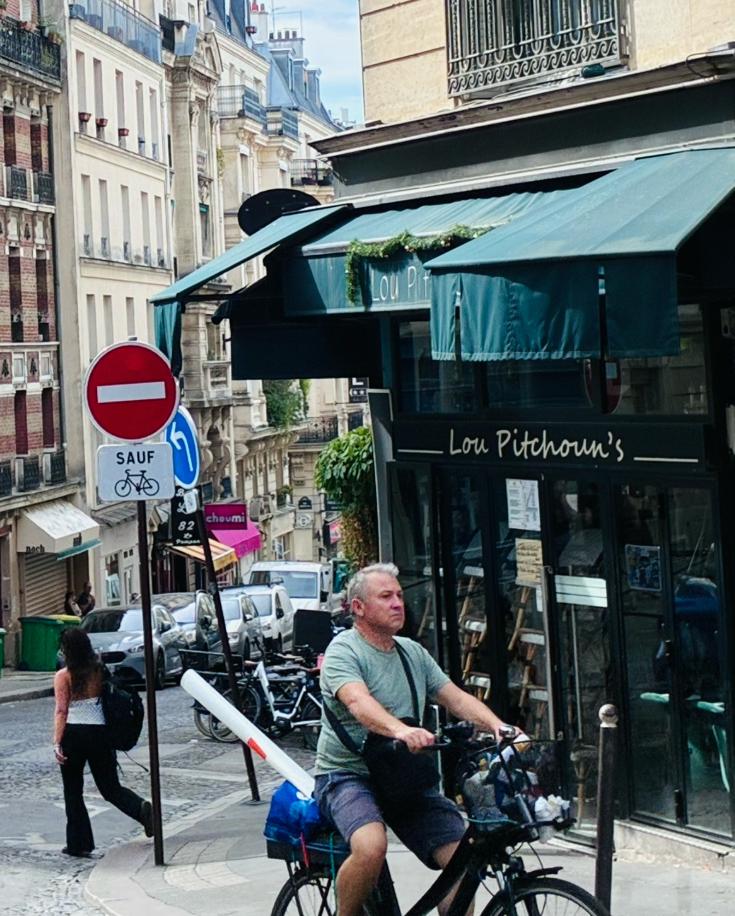
A man on a bike, Montmartre — carrying a long tube of something, not a baguette
3. Man on a Bike
There’s then a quick clip of a man riding on his bicycle in Montmartre, carrying a long tube of something – not a baguette, happily swinging by a no-entry sign. Another symbol for the surrealist in you.
This same day took me into the Grand Palais, to an exhibition that if you love abstract art you will love too — more on Hilma af Klint in my next post, Postcards from Paris: Hilma af Klint at the Grand Palais.
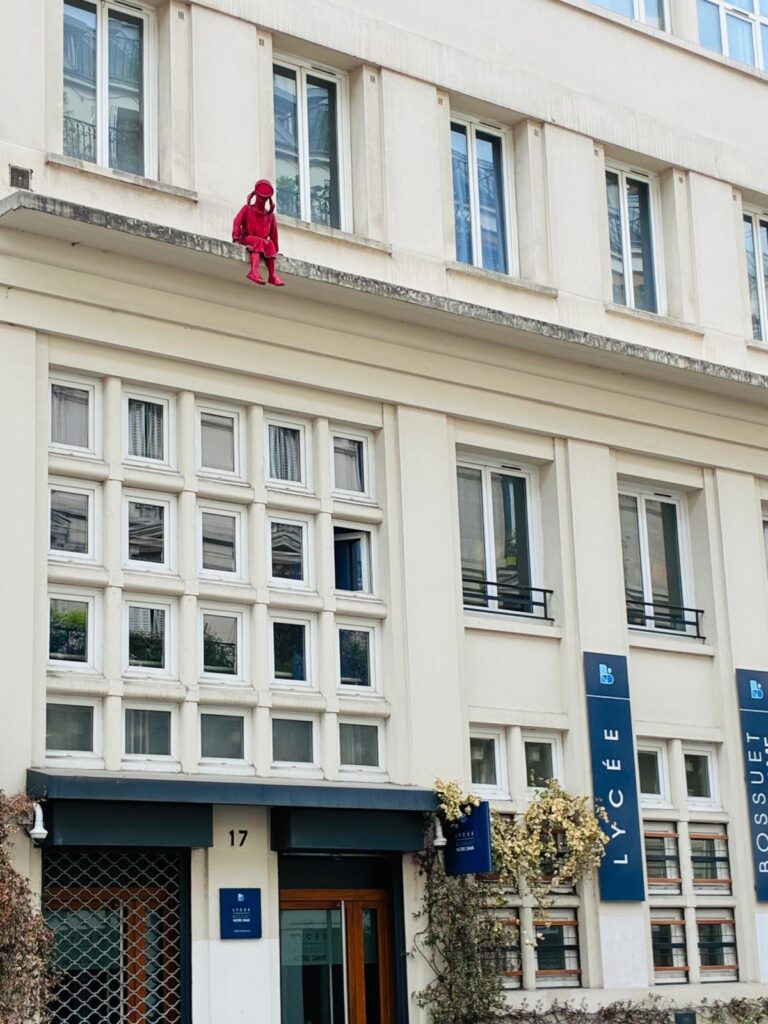
11. Red Child in the Window
Sculpture, a child in red sitting looking down from a top-storey window ledge onto the streets of Montmartre. It’s all around, these signs that get you to stop and look – that’s why the surrealists loved it here.
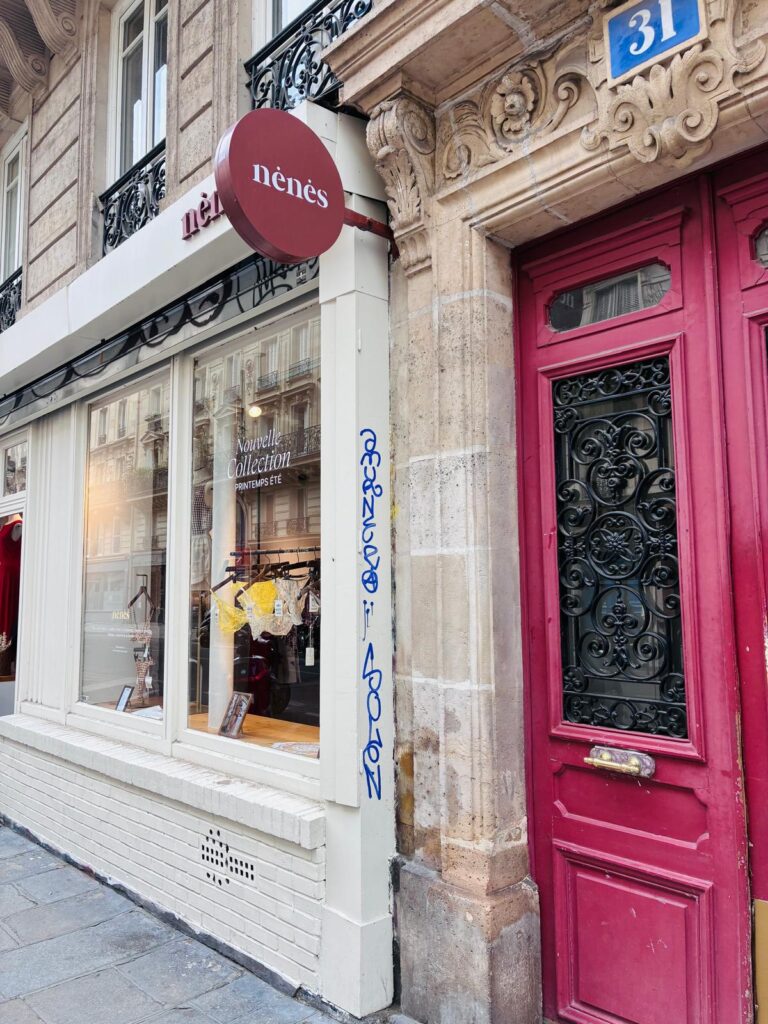
12. Nenes
A lingerie boutique. In Turkish-Cypriot Nene means grandma, and in French, Nenes is a quick way of saying boobs! Hmm, grannies’ boobs, not so good. Another juxtaposition.
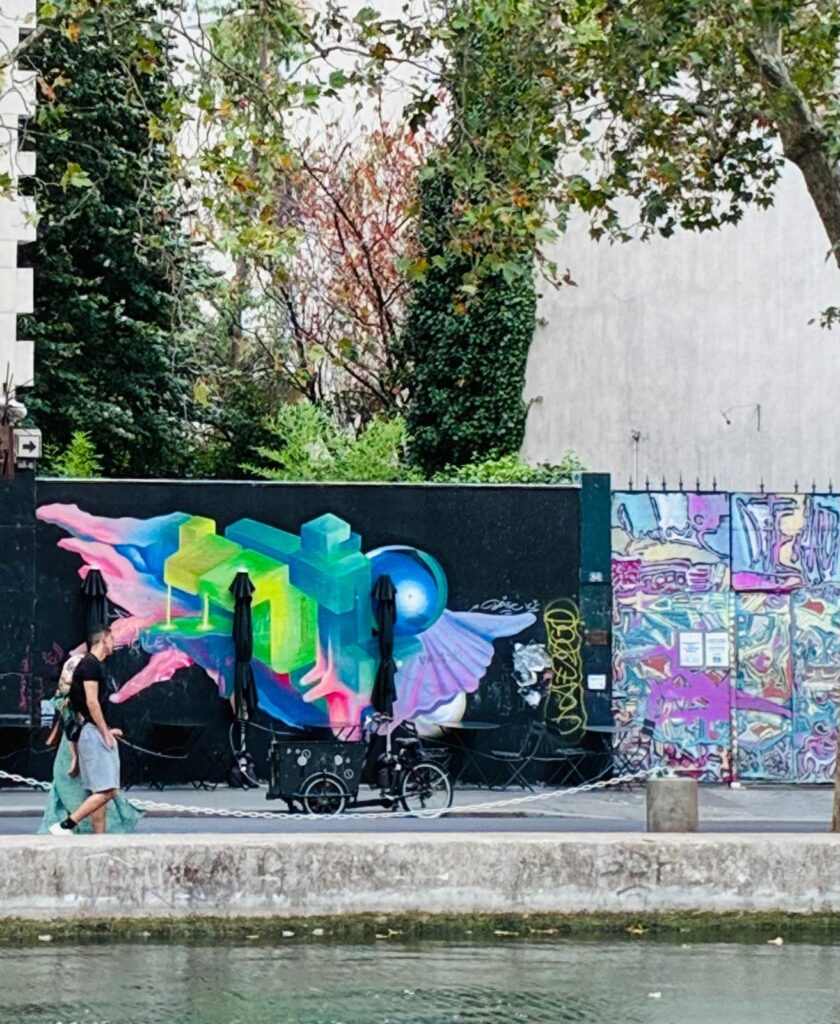
13/14. The Canal
Walking along the banks of the 10th Arr. you have the Quai de Valmy. The canal is lined with trees and bridges and it’s where we saw young gymnasts on their days off, back-flipping from ropes into the water. You’ll also spot graffiti art, some given pride of place and others lighting up neglected corners. A tag calls out “Universal Humanity” under a smiling face.
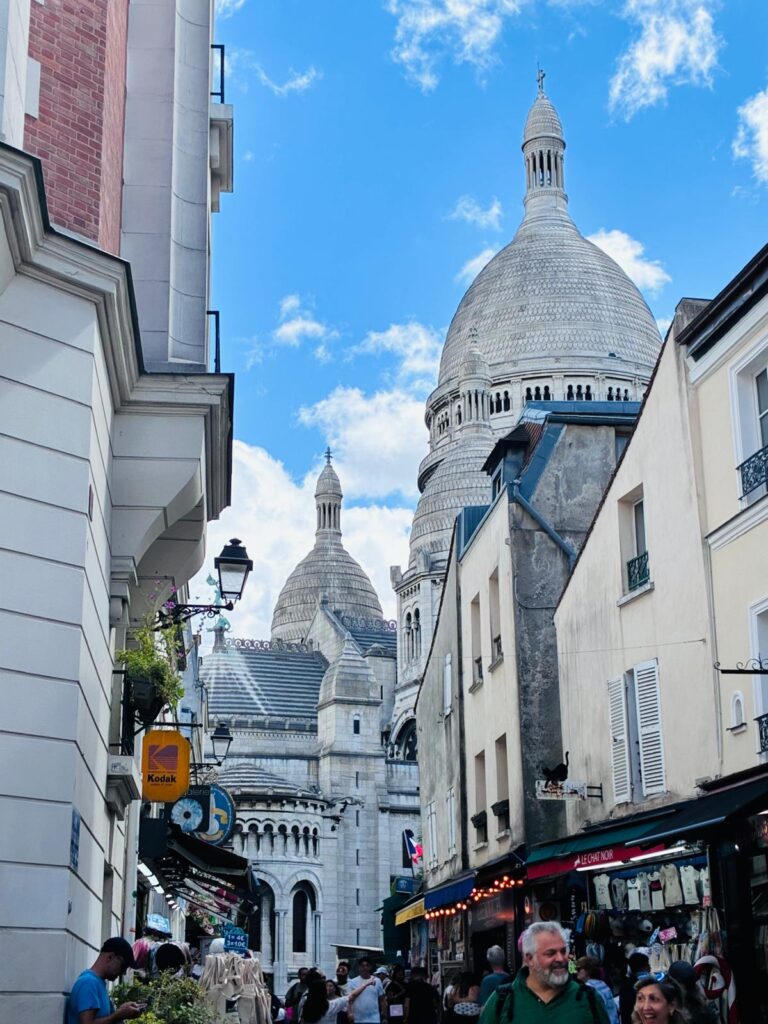
15. Montmartre at the Top
Busy streets with tourists and the view over Paris. There are a lot of independent stores scattered around the back streets. Here, a gallery — Paul / Art & Design. I would recommend the Musée de Montmartre. There are lots of fabulous posters from the early 1900s and a model of the city that lights up. Great coffee shop and garden too, where the building is elegantly dressed in French grey shutters. You’ll find all the street artists at the top, where you can get your portrait drawn or a quirky spitting-image likeness. Around the portrait artists are lots of tourist shops and bars/cafés where they like to serve you quickly to move you on. I’d rather stay and graze down where the pace is slower.
16. The Sacré-Cœur Basilica
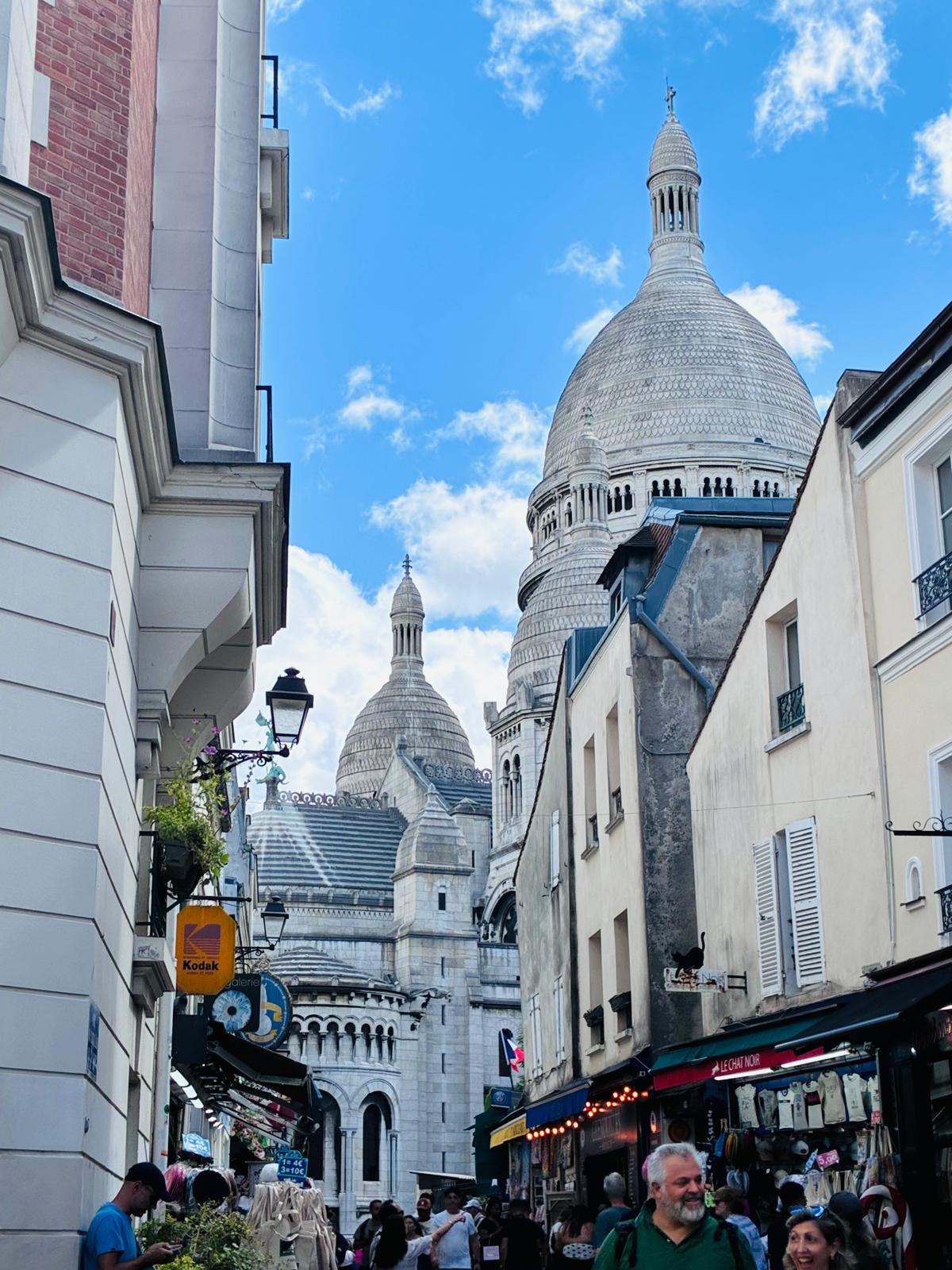
A short stroll up the hill offers panoramic views across Paris. In the evenings the young couples bring wine and sit on the steps drinking and watching the sun fall over the city. I don’t go into this church, it’s too busy, and I prefer the Montmartre Catholic one below, but it’s a great backdrop and sits on the horizon, following you on your way down.
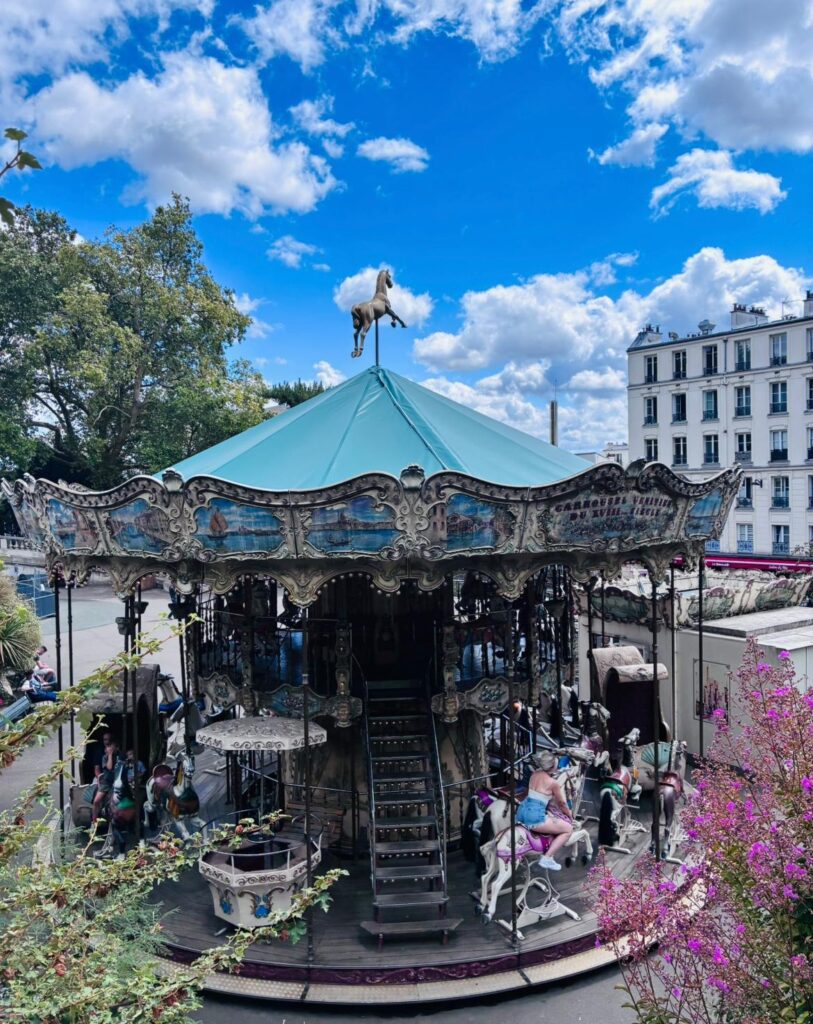
17. Carrousel de Saint-Pierre
It appears in one of my all-time favourite movies, Amélie, again Montmartre in the square below the Sacré-Cœur. I love this movie, it’s so evocative in its green and red filters. The director Jean-Pierre Jeunet paints a whimsical depiction of Parisian life – the entire movie is a painting. I highly recommend you get your Amélie fix before you visit the area. Then you can sit in the café that’s central to the film and the locality will mean so much more. Spot the lovely wooden horse on top of its canopy, blink and you’ll miss it.
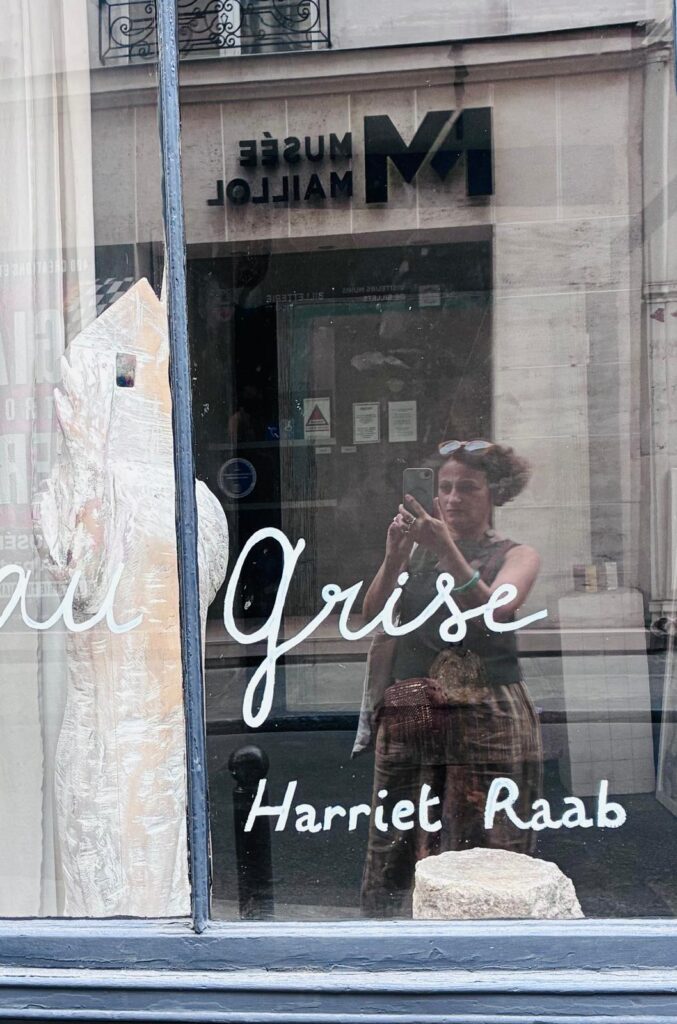
18/19. Harriet Raab’s Art
Tourrette gallery. The shop window reflection caught me in it. Harriet Raab is a really interesting artist worth a look. Check out her work on her Instagram
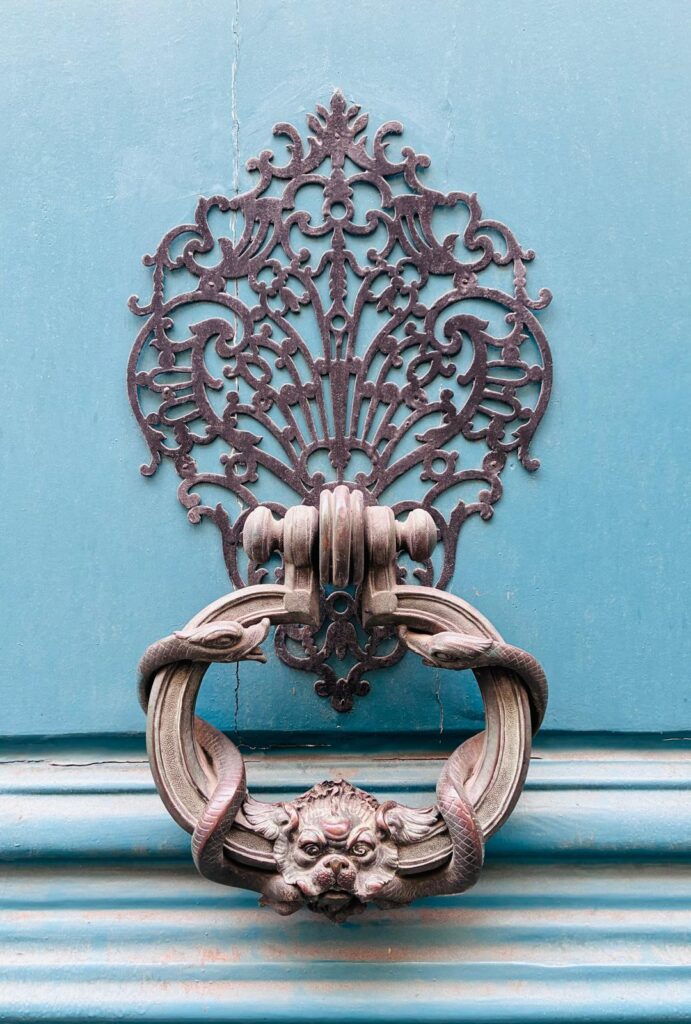
20. Door Knockers
There are beautiful ornate door accessories all over Paris, I loved the pairing of this one with the teal blue paint.
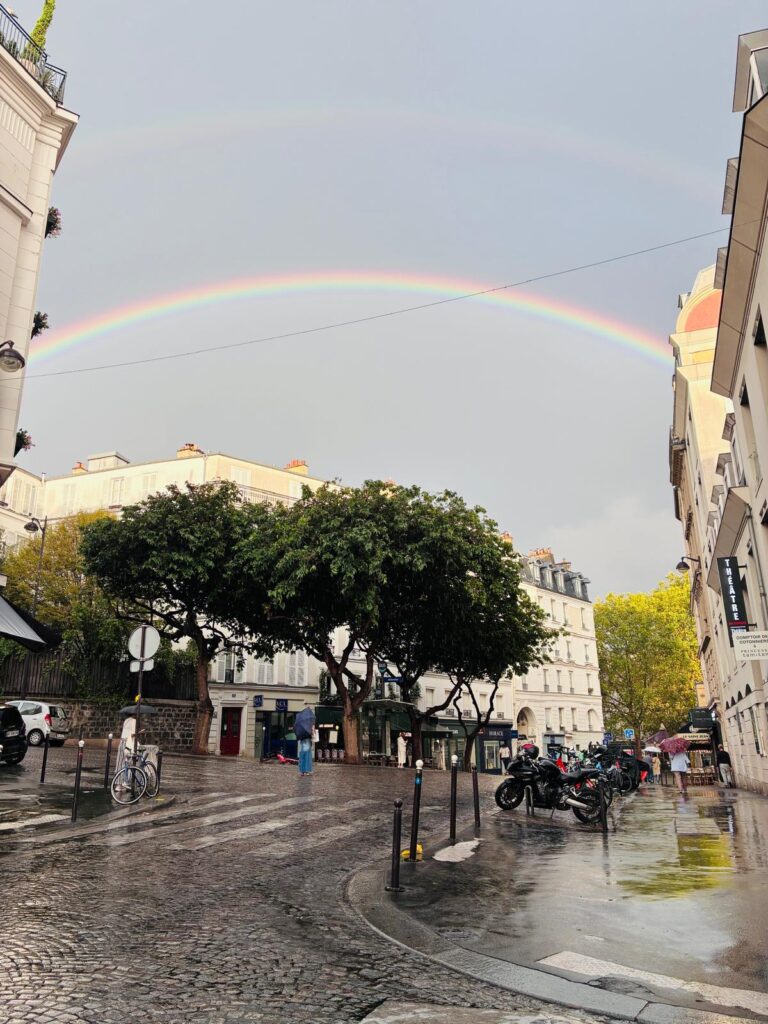
21. A Rainbow
On the evening before we left Paris it drizzled a little and a rainbow filled the sky over Montmartre as we sat drinking a small beer. We walked into the Paroisse Catholique church St Jean de Montmartre. Its interior walls are painted in black. The night before it seemed very dark, with dead windows, but now the ornate stained-glass windows came into their own, casting rainbows all over the seats, making the floor dance, with vacant parishioners. The drama, an apparition, Hilma would love this. Messages from the other side? It’s free entry and worth a visit. I always light a candle for my lost loved ones here.
Hope you enjoyed the photos, reel and the journey.
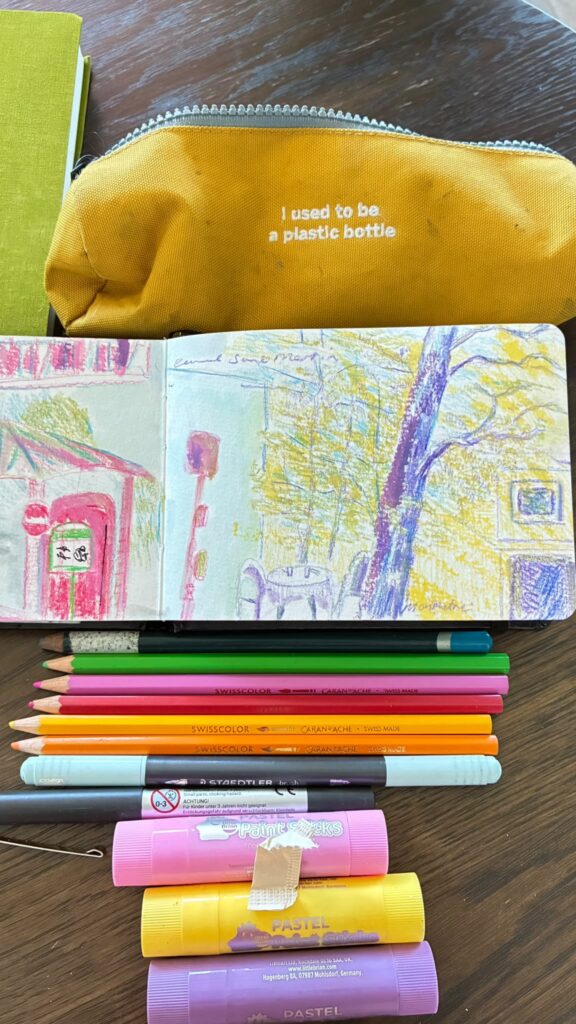
Top Tip for Artists: Keep it Simple
People won’t bother you if you are consumed in your art. Travel light. I have a small pencil case with a few colours, the tools I like to work with: water-soluble pencils, my favourite colours normally blues, pinks and yellow, a couple of Caran d’Ache crayons and a few pastel sticks. I carry a small pocket sketchbook, so it doesn’t take up too much room, especially on the small coffee tables at the bars.
Stop and breathe and spend time just looking. Take in the moment and drink your drink. What catches your eye?
It can help to take a photo; it’s like a little window into cutting down all the noise around you. But be careful, don’t be a slave to the photo.
When drawing it can also help to turn the photo into black and white. Look at the photo and look out into the view – what is missing? Compare the photo and the view. This should help you work out what’s important to you and remember you don’t need to include everything.
Be selective and put in the things you enjoy. Sometimes I move trees around or add another lamp post, whatever captures your feeling of that moment. I think of a drawing in a sketchbook as a quick impression. I like to capture less than a photo, that feeling of being there in that moment, and abstracting. You select the things you like and exclude others, making choices and importantly simplifying what you see. People won’t bother you if you’re consumed in your art and if they do, it’s fun to say hi and they run away!
Also notice how, when you look with your eyes, the picture and colours are always better than a camera. Why is that? I think it’s because you see with heart.
Enjoy your time in Paris, especially your me-time drawing. Hope this is helpful, and feel free to message me for any other tips.
If you want the art history behind this trip too, I’ve written a second post on Hilma af Klint, the artist whose show at the Grand Palais stopped me in my tracks: Postcards from Paris: Hilma af Klint at the Grand Palais.
Be well Love Rosie