Postcards from Paris: Hilma af Klint at the Grand Palais
This post picks up from my other post from the same trip, Postcards from Paris: Wandering Montmartre — this part deserved its own space. It’s also part of the same Instagram reel, images 4 to 10 if you’re following along.
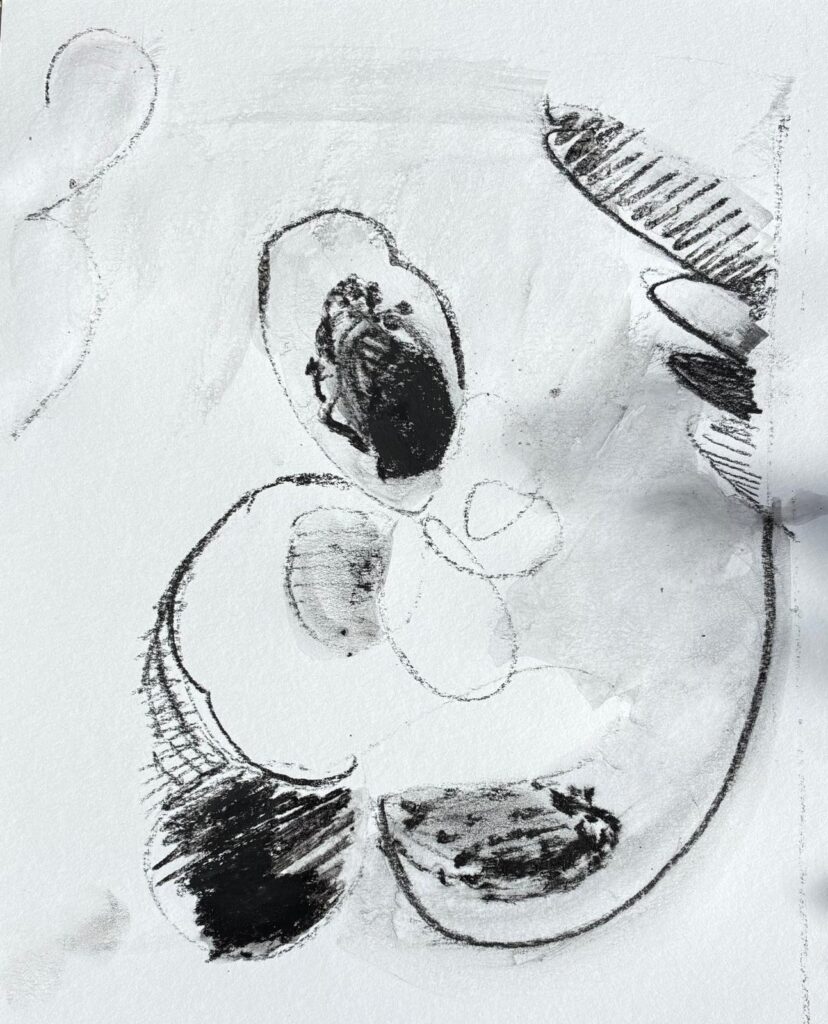
I jumped at the chance to see the art of Hilma again. She had a large retrospective at The Tate Modern in 2023, and at the time, I felt it would be a great way to introduce the surrealist process into my art classes. A less traditional art class, I had the students breathing with their eyes closed and thinking back to a moment in time to bring forward a feeling. These were turned into loose charcoal drawings and then ink using a limited palette like Hilma. See below for the lesson plan – an exercise in drawing like Hilma and the surrealists that followed her.
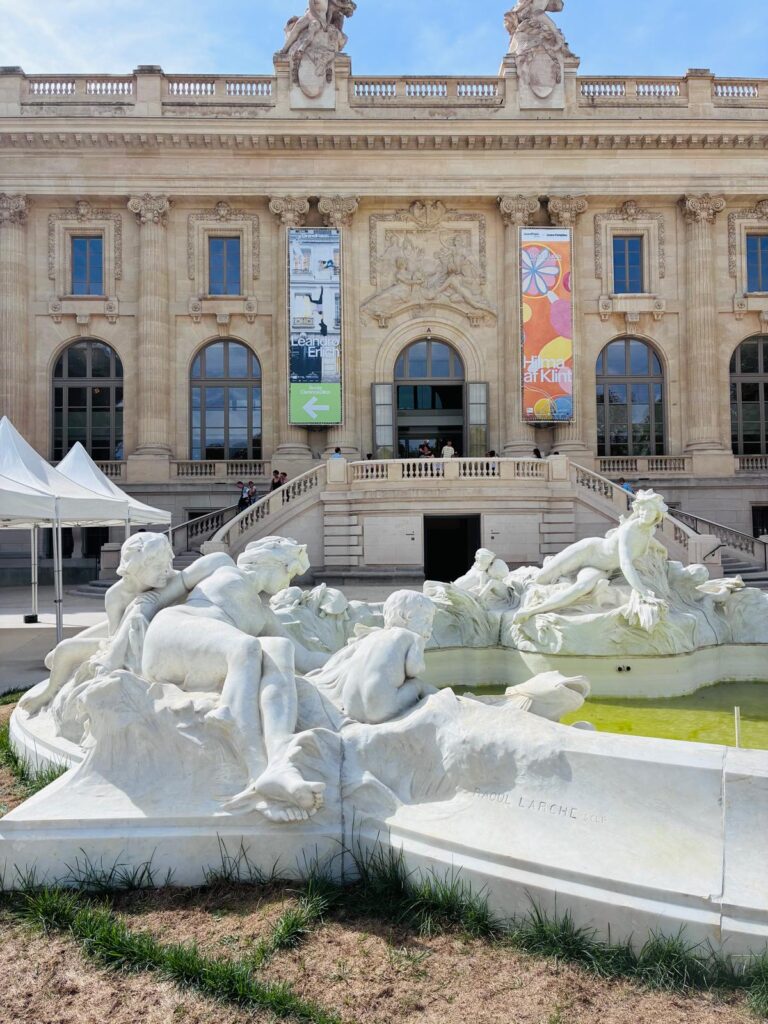
The Grand Palais
This photo was taken on arrival at the grand entrance to the Grand Palais. It has Al abbas marble figures (by Raoul Larche) lounging round the fountain and huge banners that greet you – Hilma is here – you won’t miss her iconic geometric painting on arrival. The building is stunning, and if you’re going to Paris I would highly recommend you go there. It started life as the 1900 World’s Fair in Paris. During the First World War it became a military hospital. It’s taken four years to renovate the entire building. It was used during the Paris Olympics for fencing. It’s now a place for performances, exhibitions, a great bookstore, restaurants, coffee bars and a shop. It has the largest glass roof in Europe, with vaulted ceilings. The central palace has mosaics, sculptures and gold gilt leaves, soo beautiful. I couldn’t stop taking photos, it’s amazing. I got it down to a couple on Instagram.
It’s open Tuesday to Sunday. Hilma has already moved on to Dublin https://www.visitdublin.com/national-gallery-of-ireland now (15 October 2026 – 7 February 2027), but Paul Cézanne, another favourite of mine, is on now until January 2027! What a treat.
Grand Palais, Square Jean Perrin, 17 Avenue du Général Eisenhower, 75008 Paris.
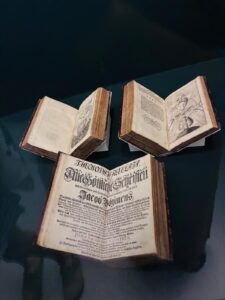
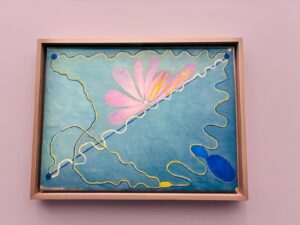
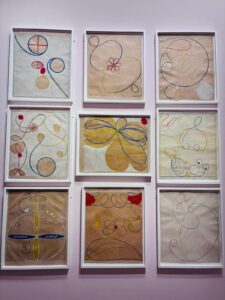
Hilma af Klint (1862–1944)
She was one of Sweden’s most esteemed artists. She was formally trained at the Royal Academy of Fine Arts in Stockholm. The first abstract artist, and yet not many people know about her. The men we hear about, Wassily Kandinsky and Piet Mondrian, but they were influenced by her directly. Another woman overlooked in the art history books.
Her Books
She studied a number of books, with interest in the ideas of Rosicrucianism, Theosophy and Anthroposophy. These modes of spiritual engagement were part of the zeitgeist and popular across Europe – especially in artistic and literary circles – as people sought to reconcile religious beliefs with scientific advances. Her paintings are inspired by her conversations with the spirit world and she often took part in séances.
Hilma’s Art
Her paintings are large technical drawings with washes of colour that become beautiful abstract paintings. She works on paper and canvas in a variety of medium. I include a photo of a loose flower painting and her drawings on brown paper. You can see her paintings in Ireland at the National Gallery of Ireland in Dublin, from October 15 to February 7 2027.
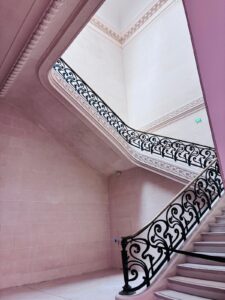
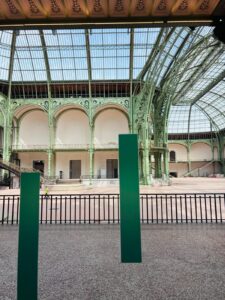
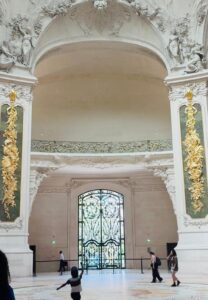
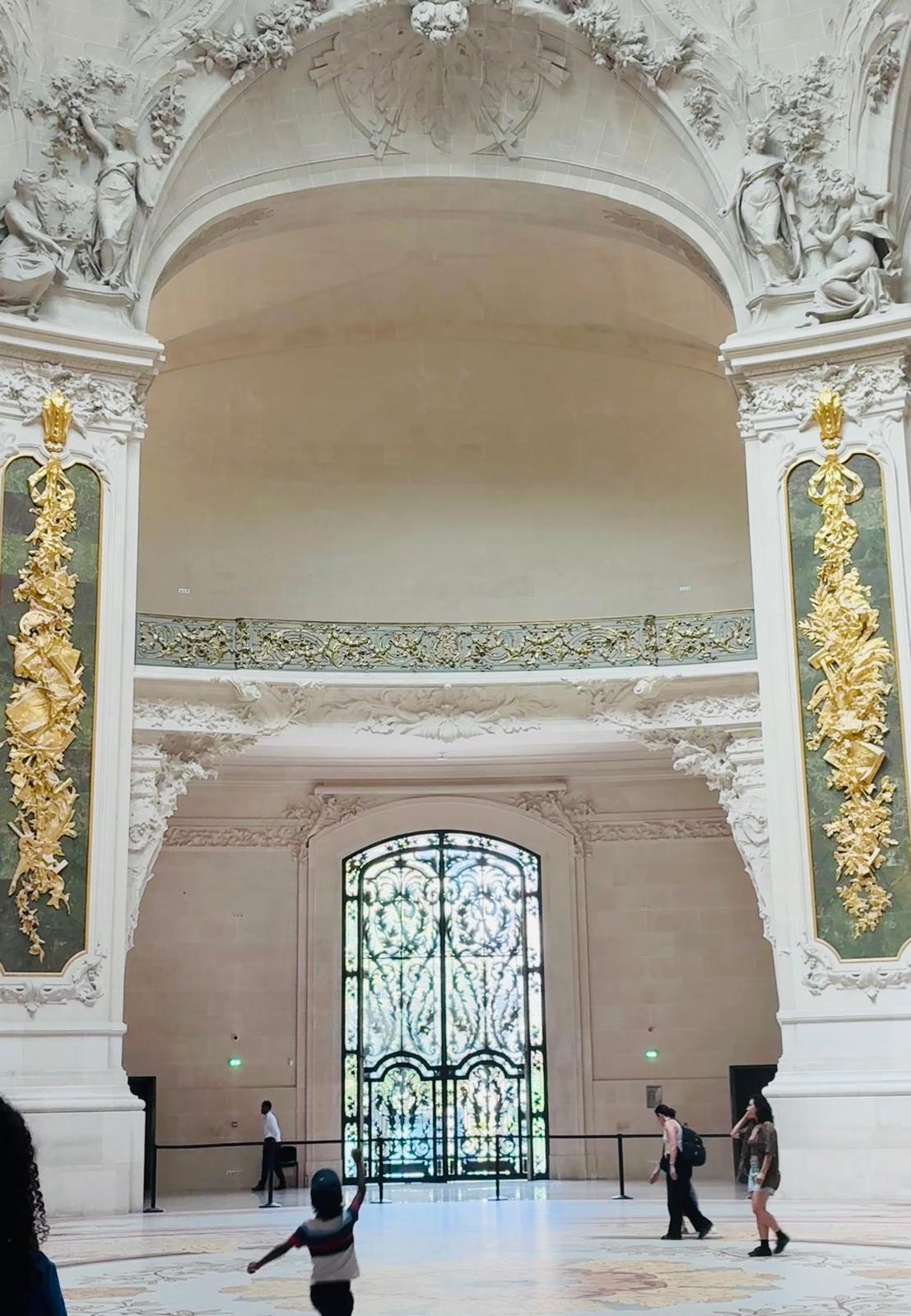
Inside the Grand Palais
It has glass doors with matching green rectangles that echo the railings. The staircase is elegant and divine, gliding up into the immense expanse of light, and worthy of a few photos too. Also, beautiful ironwork in green and black.
If this is the kind of thing that catches your eye too, come and wander the rest of Montmartre with me in my other post from this trip, [link to Blog 1] — the streets, the canal, and a rainbow through stained glass.
If this is the kind of thing that catches your eye too, come and wander the rest of Montmartre with me in my other post from this trip, the streets, the canal, and a rainbow through stained glass.
I’ll be thinking about her paintings for a long time. Some artists just get under your skin like that. If you get to see her work yourself, I’d love to hear what you think of it.
Inspired by Hilma, Towards Abstraction with Rosie
Drawing Exercise from the Unconscious
Hilma’s paintings to me offer lessons in abstraction – to simplify what you feel/see.
What you will need. Sketch book or paper (weight 150gsm or more). Charcoal: willow and compressed, putty rubber, medium brush and water in a pot. Kitchen paper, two sheets. Extension: Drawing ink.
Set the scene. It helps to set the scene, and I normally will play some music, be it the sound of the sea or relaxing yoga music. Breathe in with your nose and EYES SHUT!
Make sure you know where the edges of your page are.
Start with Willow Charcoal as it is easy to use and has a lot of variety. Use the compressed charcoal at the end for added darkness – it can dominate.
- Drawing 1: Continual line. The drawing stays on the page and you do not lift so it flows. Like the surrealists, a continual line allowing the unconscious to move your hand. Try not to think. 3 minutes.
- Drawing 2: Wrong arm. Then shift to another page and use the wrong arm, same again but this time you can lift the charcoal off the page. Keep breathing steady in and out and allow your hand to follow your breath. Pause and allow your mind to draw a picture. 3 minutes.
Open your eyes.
What do you see? What emotion is there? Is the drawing soft, gentle, or jagged, skippy, dark, fleeting? Drawing with emotion will vary your lines.
When I teach, I talk about the visual vocabulary. Having a vast range of marks and ways of using each tool is important.
Drawing 3: Pushing your drawing techniques. Try these techniques:
- Draw with the tip of the charcoal.
- Now laying the charcoal flat on the paper and drag it.
- Using your charcoal shade in any areas. Create a soft, medium and dark tones.
- Use your putty rubber to clean up edges and then highlight by rubbing out areas.
- Press your putty rubber onto your charcoal drawing. This will lift the grey and you can press it into another area.
- Twisting your charcoal, between the index finger and thumb – rolling. I would tell my primary school children to glide their charcoal and let it dance.
Building your skills in mark making is crucial to have a better drawing and building a visual vocabulary. And feelings can be illustrated in a drawing.
Drawing 4. Now select an area of your drawing and repeat on a new page, pulling out any forms or shapes that appeal to you. It could be the whole thing or just a small section.
Have you tried using water over charcoal? It’s water-soluble.
- Try washing over some of the charcoal lines – it will create a grey tone.
- If you then draw into the wet areas, you get another type of mark – a scruffy buffing line. I like this mark.
- When the page is dry go over again, this time heavier and select another area to wet – the tones should be darker and varied. You will have a contrast between the white of the page and the grey washes.
- When the page is wet you can also use kitchen paper to lift off areas of water to leave another type of mark/grey.
Extension: Black Ink. If you’re enjoying this, now introduce some black ink. The same process, working with neat ink or adding to an area of pooled water.
- The ink into wet areas creates lovely butterfly like expansions.
- Ink onto dry areas will stay put.
- You can also lift the ink with kitchen paper and this leaves interesting marks and may leave a relief from the pattern on the paper.
There you have it, four abstract drawings and a process to create from your unconscious. It’s how I warm my students up, before a longer drawing in class.
I hope you enjoy it. Let me know what you think.
If you’re near Dublin before February, her paintings are showing at the National Gallery of Ireland. If it’s Paris you’re headed to instead, Cézanne’s the one on now at the Grand Palais.
Be well Love Rosie